Blog

SaleStream CRM vs Tupelo | Automation for Business Brokers

Why Broker Automation Is the Real Competitive Advantage (And Most CRMs Don’t Have It)

The Bottleneck Most Brokers Accept
Ask most brokers what slows them down, and the answers are familiar:
Too many emails.
Too many follow-ups.
Too many moving parts.
What they are really describing is one thing:
Manual work.

The Reality of Daily Brokerage Operations
Even experienced brokers spend a significant portion of their time on:
Following up with buyers
Requesting documents
Tracking deal progress
Managing deadlines
Coordinating between parties
These tasks are necessary.
But they are also repetitive.
And repetition limits scale.

Where Most CRM Platforms Fall Short
Platforms like Tupelo help brokers organize their work:
Contacts are stored
Pipelines are visible
Notes are tracked
But organization is not automation.
When real work begins:
Follow-ups are still manual
Tasks must be created manually
Deadlines are tracked separately
Brokers must actively manage every step
The system supports the broker—but does not reduce workload.

Why This Matters for Growth
Manual processes create a ceiling:
More deals = more work
More clients = more communication
More activity = more complexity
Eventually, brokers reach a limit:
They cannot handle more deals without sacrificing quality.

SaleStream CRM: Automation Built Into the Workflow
SaleStream CRM was designed to remove this limitation.
Instead of helping brokers manage work, it helps eliminate it.

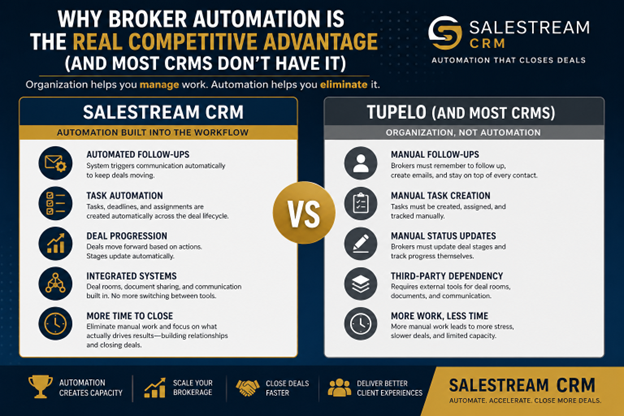
Automated Follow-Ups That Keep Deals Moving
Instead of remembering to follow up:
The system triggers communication automatically
Buyers and sellers stay engaged
Momentum is maintained
No gaps. No delays.

Task Automation Across the Entire Deal Lifecycle
From onboarding to closing:
Tasks are created automatically
Deadlines are calculated
Responsibilities are assigned
Brokers no longer build workflows manually.

Deal Progression Without Manual Updates
Instead of updating statuses:
Deals move forward based on actions
Triggers update stages automatically
Progress is always current
This reduces administrative effort significantly.

Integrated Systems That Replace External Tools
Unlike many CRMs:
Deal rooms are built in
Document sharing is centralized
Communication is connected
No need to switch between platforms.

The Difference Between Working and Scaling
Without automation:
Brokers work harder
Growth slows
Stress increases
With automation:
Workload decreases
Efficiency improves
Capacity expands
This is what allows brokerages to scale.

The Competitive Reality
CRMs like Tupelo help organize activity.
SaleStream CRM reduces activity.
That difference is critical.
Because:
Organization manages complexity
Automation removes complexity

The Real Advantage: Time
Automation gives brokers something they cannot create manually:
Time.
Time to:
Focus on negotiations
Build relationships
Close deals
Instead of managing tasks.

Final Thought
The future of business brokerage is not about doing more work.
It is about doing less manual work—and closing more deals.
Most CRM platforms stop at organization.
SaleStream CRM goes further—by automating execution.

Share This Blog Post

Leave a Comment

Your email address will not be published. Required fields are marked *

Related Articles

You May Also Like

Continue reading insights on listings, NDAs, deal management, and closing workflows. Learn how smarter workflows and automation help teams save time and close more deals.

See SaleStream in Action

A short walkthrough tailored to how your brokerage operates. No pressure. No obligation.

What you’ll see

Who it’s for

Request a demo
We’ll confirm a time by email. (Connect to Calendly or your booking flow.)
Scroll to Top