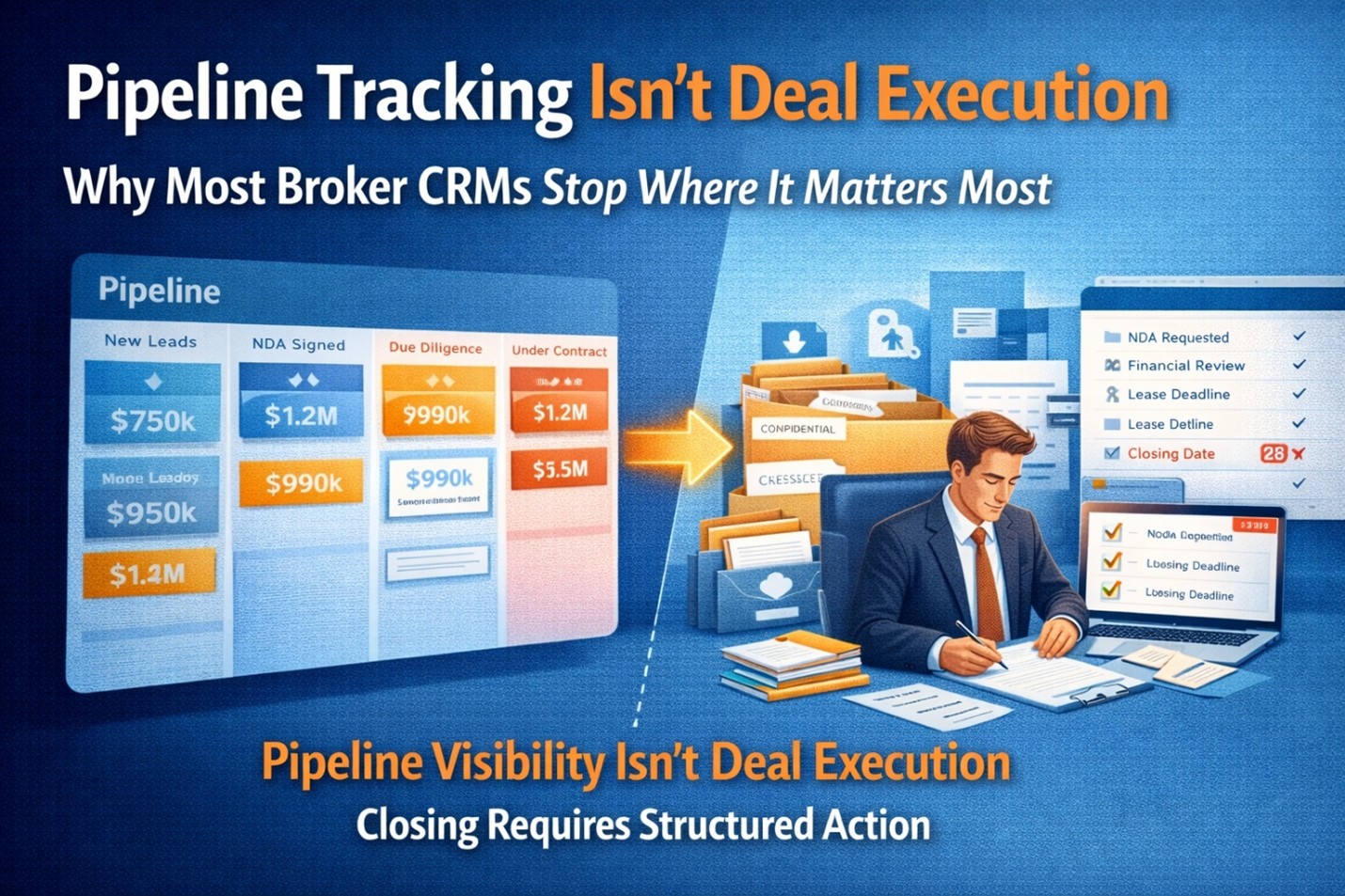
Pipeline Tracking Isn’t Deal Execution: Why Most Broker CRMs Stop Where It Matters Most
Most CRM solutions for business brokers proudly advertise pipeline tracking.
Visual dashboards.
Color-coded deal stages.
Kanban-style boards.
And while those tools are useful, there’s a fundamental question brokers should ask:
Does pipeline tracking actually help me close deals?
Because seeing a deal move across a board is not the same as moving it forward in reality.
What Pipeline-Focused CRMs Typically Offer
Many CRM platforms in the brokerage space emphasize:
Contact tracking
Listing status stages
Lead-to-buyer pipelines
Reporting dashboards
Activity logs
These tools provide visibility.
But visibility is not execution.
Where the Gap Appears
Once a deal moves beyond initial inquiry, brokers must manage:
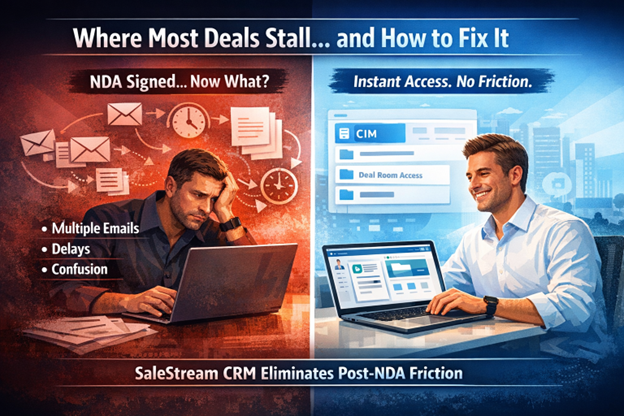
NDA progression
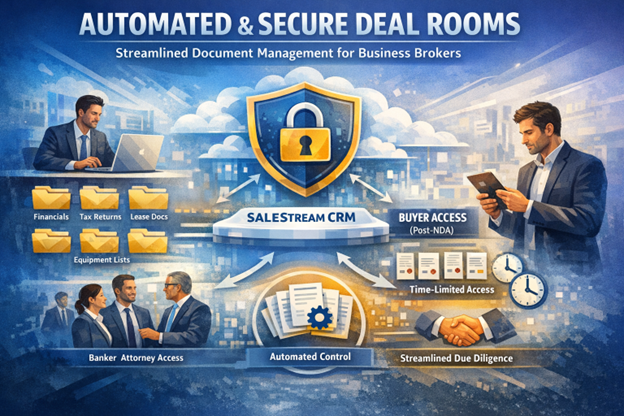
Confidential document access
Buyer engagement
Financial review coordination
Third-party communication
Under-contract deadlines
Task accountability
Closing preparation
Most CRMs continue to show a “stage” label—but do not structurally support what must happen inside that stage.
As a result, brokers still rely on:
Spreadsheets
Email reminders
Manual follow-ups
Separate task tools
The CRM becomes a tracking board—not an execution system.
SaleStream’s Structural Advantage: Deal Execution Architecture
SaleStream CRM was built with a different philosophy:
A brokerage CRM must actively support the transaction lifecycle—not just visualize it.
1. Workflow Integrated Into Each Deal Stage
Instead of static pipeline labels, SaleStream is designed around structured transitions:
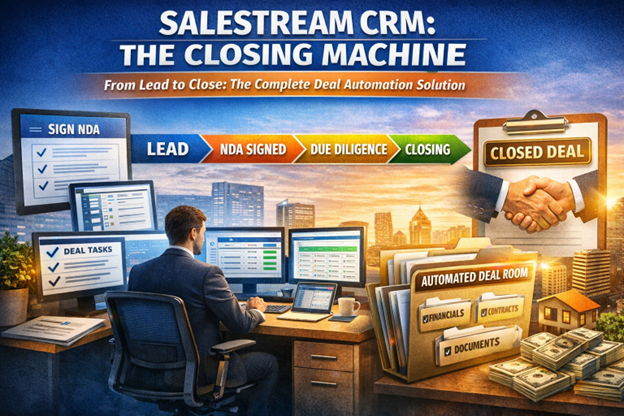
Seller Intake → Listing → NDA → Deal Room → Under Contract → Closing
Each stage connects to real operational workflows.
That means brokers aren’t just seeing where a deal is—they are supported in advancing it.
2. Tasks and Deadlines Are Embedded, Not External
When deals go under contract, execution complexity increases.
SaleStream supports:
Structured task templates
Clear responsibility assignment
Visibility across the team
Defined next steps
This turns under-contract management into a repeatable process—not a reactive scramble.
3. Reduced Reliance on Manual Oversight
Pipeline-only systems require brokers to remember:
Who needs follow-up
Which documents were shared
What deadline is approaching
Which stage a deal should move to next
SaleStream reduces reliance on memory and manual tracking by embedding structure into the workflow itself.
Why This Matters for Brokerages
Brokerage profitability depends on:
Closing velocity
Reduced deal fallout
Operational efficiency
Scalability
If a CRM stops being helpful once a buyer is serious, brokers are forced to compensate with manual effort.
Over time, that limits capacity.
A structured execution system, by contrast, increases consistency and reduces friction across every deal.
The Competitive Reality
Many CRM solutions for business brokers are adapted sales CRMs.
They excel at:
Storing contact data
Sending email campaigns
Tracking listing inquiries
But they are not designed as transaction execution engines.
SaleStream was built specifically to manage brokerage operations end-to-end.
Final Thought
If your CRM gives you a beautiful dashboard but still requires spreadsheets to close deals, it may not be solving the right problem.
Modern brokerages need systems that:
Track deals
Advance deals
Execute deals
Not just display them.
SaleStream CRM was designed for that full lifecycle.
Contact Us: http://www.salestreamcrm.com
720-361-1000
Book a Meeting: